


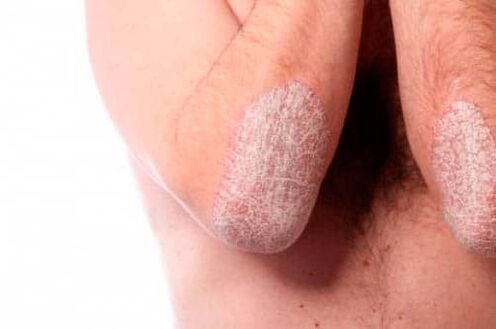
Despite the fact that psoriasis is a common and long-known disease, it has not yet been fully studied.And most of the time, patients do not know that psoriasis is not a bacterial or fungal infection, but an atypical reaction of the immune system, caused by unknown reasons.Information about the causes and symptoms of psoriasis will be very useful for patients as it will help to overcome the disease.
What kind of disease is this?
Scaly lichen is another name for psoriasis, and this name perfectly characterizes this disease.Psoriasis manifests itself in the formation of inflamed plaques of varying sizes on the skin, which are densely covered with thick skin scales.
Surely, almost everyone has heard of such a disease as psoriasis.And this is not surprising, since scaly lichen is quite widespread.This disease is diagnosed in 4-10% of the world's population.Furthermore, statisticians who collect information on the prevalence of psoriasis say that the number of patients is constantly growing.
Scaly lichen has been known to people since ancient times;Even ancient Greek healers tried to treat this disease.The modern history of the study of psoriasis dates back about 150 years.But during this very significant period, researchers were unable to learn enough about the causes and treatment of psoriasis.
Widespread prevalence, uncertainty of etiology (reasons for appearance), insufficiently effective treatment - all this characterizes psoriasis as one of the most difficult problems in dermatology.
Today, dermatologists consider psoriasis to be a complex systemic disease associated with disturbances in the functioning of the immune system, the failure of metabolic processes and the appearance of trophic disorders.The result of these failures are specific skin changes.
Therefore, answering the question of what psoriasis is, a modern dermatologist will answer that these are disorders of trophism and metabolic processes in the skin caused by a malfunction of the body's systems.Today, two theories about the etiology of psoriasis are considered the most likely: genetic and viral.
- The genetic theory has many supporters, since psoriasis often acts as a hereditary or familial dermatosis.A thorough examination of the patient's family history confirms in 60-80% the presence of psoriasis in one form or another in the patient's family members.However, in some patients it is not possible to confirm the hereditary origin of psoriasis.This circumstance is the reason to separate these cases into a special group, in which the main cause is not genetic faults, but phenotypic faults.
- The viral theory, according to which psoriasis develops as a result of an infection, has its supporters.Confirmation of information about the viral origin of psoriasis is the detection of antibodies in the blood of patients, as well as “elementary bodies” in the cells of the epidermis.According to this theory, psoriasis develops not only in case of infection with a virus, but also in the presence of certain conditions.
There are other theories that explain the appearance of psoriasis.For example, endocrine, neurogenic, metabolic, etc.Naturally, all these theories are not unfounded and their study allows us to obtain more important information about the disease psoriasis.However, today it is already known for sure that the state of the endocrine and nervous systems, as well as the functioning of the gastrointestinal tract, do not cause psoriasis, but have a significant impact on the course of this disease.
For example, pathologies that affect the liver cause the quality of blood purification carried out by this organ to be greatly reduced.And this, in turn, can cause the appearance of various skin lesions, including psoriasis.
Pathologies that affect the liver (hepatitis, primary cirrhosis, etc.) lead to the degeneration of the tissues of this organ, that is, the liver is gradually replaced by connective tissue.As a result, the liver ceases to fulfill its cleansing functions.Externally, this is manifested by yellowing of the mucous membranes and skin, and the development of skin diseases, including psoriasis, is also possible.
There is also an inverse relationship: psoriasis is usually accompanied by fatty degeneration that affects the liver.Therefore, when treating this skin disease, it is important to follow a diet so as not to put unnecessary strain on the liver.Patients are advised to limit fatty foods and eliminate alcohol completely.
Thus, despite numerous studies, it was not possible to obtain an exact answer to the question of what psoriasis is.However, work continues, so there is a chance that the mystery of this mysterious disease will be solved and we will learn a lot about the skin disease psoriasis.
Classification according to the international system
Psoriasis disease manifests itself in several ways.To make it easier for experts to navigate, a generally accepted classification of psoriasis is used.
Psoriasis is also included in the International Classification of Diseases (ICD) system.Today, the 10th revision of the international registry of diseases is already in use, which is why the abbreviation ICD 10 is used. Work on the 10th revision of the international classification of diseases began in 1983 and was completed in 1987.
In essence, ICD 10 is the standard assessment tool used in medicine and healthcare management.The 10th revision of the reference book is used to monitor the prevalence of various diseases and other problems related to public health.
Using ICD version 10, it is possible to compare morbidity and mortality data in different countries, which allows statistical data to be obtained and diagnostic information to be systematized.As agreed by WHO members, ICD 10 is used to assign codes to various diseases.In version 10 of the classifier, alphanumeric codes are adopted, with which it is convenient to store information in electronic form.
All types of psoriasis are included in ICD 10 and each of them receives a specific code.In dermatology, the following forms and types of psoriasis are distinguished:
- Common psoriasis(synonyms: vulgar, simple, plate-shaped).The disease received a code according to ICD 10 – L-40.0.This is the most common form, seen in 80-90% of patients.The main symptoms are the formation of plaques raised above the surface of unchanged skin, covered with grayish-white skin scales.This form is characterized by slight peeling of the scales.After removal, red inflamed skin is revealed, which is easily injured and begins to bleed.As the inflammatory process progresses, plaques can significantly increase in size.
- Inverse psoriasis.This is a disease that affects the skin folds (flexural surfaces).For this form of the disease, the ICD 10 code is L83-4.Dermatosis appears with the formation of folds of smooth or minimally scaly patches on the skin.The condition worsens when the skin is injured by friction.The disease is often complicated by an associated streptococcal infection or fungus.
- Guttate psoriasis.This form of psoriasis is characterized by the formation of a large number of small red or purple spots on the skin, shaped like water droplets.According to the 10th version of the international classifier, this disease was assigned the L4 code.Most often, guttate psoriasis affects the skin on the legs, but rashes can also occur on other parts of the body.At the same time, it is known that guttate psoriasis develops as a complication after streptococcal infections - pharyngitis, tonsillitis, etc.
- Pustular or exudative psoriasis– this is a severe cutaneous form, according to ICD 10 it receives codes L1-3 and L 40.82.Characterized by the formation of blisters or pustules.The skin on the lesions becomes swollen, red, inflamed and peels off easily.If fungi or bacteria penetrate the pustules, the contents of the pustules become purulent.Pustular psoriasis most often affects the distal parts of the extremities, but in more severe cases, a generalized process may develop with the rash spreading over the entire body.
- Psoriatic arthritis or arthropathic psoriasis.According to the 10th version of the ICD, the pathology is coded as L5.Manifested by inflammation of the joints.Arthropathic psoriasis can affect all types of joints, but in most cases the joints of the phalanges of the fingers and toes become inflamed.The knee, hip or shoulder joints may be affected.Injuries can be so serious that they lead to the patient's disability.Therefore, you should not think of psoriasis as if it were exclusively a skin disease.Severe types of psoriasis can cause systemic damage, disability or even death to the patient.
- Erythrodermic psoriasis.Rare, but severe type of psoriasis, according to ICD 10 this disease received the code L85.Erythrodermic psoriasis often manifests itself in a generalized form;the affected area may include all or most of the skin surface.The disease is accompanied by severe itching, swelling and pain.
- Psoriatic onychodystrophy or nail psoriasis.According to ICD version 10, the disease has code L86.The pathology manifests itself as changes in the appearance of toenails and fingernails.Nails can change color, become thicker and begin to break.Possible total loss of nails.
In psoriasis, the classification of the disease takes into account not only the types of the disease, but also the severity of the symptoms:
- limited psoriasis is a disease in which less than 20% of the skin is affected;
- generalized psoriasis affects more than 20% of the body surface;
- When almost the entire surface of the skin is affected, we are talking about universal psoriasis.
If we consider all types of the disease, then generalized psoriasis is more common than other forms.
Flow stages
Limited or generalized psoriasis goes through three phases in its course: progressive, stable and regressive.
The progressive stage of psoriasis is characterized by the following:
- the appearance of new rashes;
- growth of existing plaques;
- the appearance of new elements of the rash at the site of skin lesions (scratches, abrasions);
- excessive peeling of existing plaques.
The following symptoms are characteristic of the stationary stage of psoriasis:
- lack of emergence of new elements;
- moderate peeling of elements;
- no signs of element growth.
The appearance of folds in the stratum corneum around the elements is a sign of the transition from the stationary to the regressive stage.
The regression phase is characterized by the following types of symptoms:
- reducing the intensity of peeling;
- element resolution.
After psoriatic plaques resolve, hypo- or hyperpigmented patches remain in their place.
Squamous lichen is characterized by a long course with periodic exacerbations.The following types of psoriasis are distinguished:
- winter (worsening in autumn and winter);
- summer (with exacerbations in the hot period);
- Non-seasonal psoriasis is the most serious type, as there is no clear link between relapses and seasons, periods of remission can be practically absent.
Diagnostic features
If psoriasis has a typical clinical picture, the diagnosis will not be so difficult.However, this disease is often disguised as other pathologies.
For example, nail psoriasis is often confused with nail fungus, since the external manifestations in the initial stages of these diseases are very similar.However, nail fungus and psoriasis have completely different natures, so treatment must be different.
A non-specialist may confuse it with a fungus and skin psoriasis.Cutaneous mycoses (fungi on the skin) manifest with similar symptoms - the formation of scaly plaques.Therefore, if you notice suspicious symptoms on the body or nails, you do not need to diagnose it yourself and start treating the fungus with pharmaceutical or folk remedies.
If the diagnosis is wrong and, in fact, the cause of the symptoms is not a fungus, but rather psoriasis, treatment will not be beneficial but, on the contrary, will worsen the symptoms.
When you contact a dermatologist, a fungus test will be performed and a nail or skin scraping will be taken.Then the resulting material is placed in a nutrient medium.If the fungus is present in the material, within a few days a large colony will grow in the test sample.By the appearance of the material, it will be possible to understand what type of fungus caused the infection.
Sometimes psoriasis is complicated by the addition of secondary infections, which may be a bacterial or fungal infection.Therefore, patients who present a change in the clinical picture (appearance of purulent secretion, change in the color of the plaques, etc.) You will have to undergo periodic tests to detect fungi and other infectious agents.
In the diagnostic process, a certain role is assigned to a set of phenomena called the psoriatic triad.The phenomena appear sequentially when one element of the rash is scraped off.
The psoriatic triad manifests itself as follows:
- when an element of the rash is scraped, the scales are removed in the form of “chips”;
- after removing the chips, a thin transparent film similar to polyethylene is revealed;
- When the film is damaged, pinpoint bleeding occurs.
A dermatologist diagnoses psoriasis, but if necessary, the doctor can refer the patient for consultations with other specialists - rheumatologist, gastroenterologist, surgeon, etc.
Interesting facts about psoriasis
People have known about the disease psoriasis since ancient times.Even the name of the disease came to our language from ancient Greek.During the prosperity of Ancient Hellas, the word “psora” meant all skin diseases that manifested as scaling and itching.
The first person to write a detailed treatise on psoriasis was a Roman named Cornelius Celsus.In the fifth volume of his work “On Medicine” there is an extensive chapter dedicated to this disease.
They knew about psoriasis, but this disease was not evaluated unequivocally, as it was called an “imperial” or “devil’s” disease.
Of course, ancient healers knew very little about psoriasis.Until the 19th century, this disease was often confused with other skin diseases.Psoriasis was first identified as an independent nosological form in 1799. This was done by the English dermatologist Robert Willan, who identified psoriasis from a large group of skin diseases manifested by itching and peeling.
Not only ordinary people, but also prominent political figures knew firsthand about psoriasis.For example, Winston Churchill, who suffered from this disease, promised to erect a monument made of pure gold to a person who could learn everything about psoriasis and offer effective treatment for this disease.
Modern ideas about the disease
It must be said that modern science does not know much about this mysterious disease.There are several theories about the origin, as well as the course and treatment of psoriasis.
Here are some facts about psoriasis that leave no doubt among experts:
- Although the causes of the disease are unclear, we were able to discover the nature of psoriasis.This disease is autoimmune, that is, it is caused by a malfunction of the immune system;
- Another proven fact about psoriasis: the disease can be hereditary.However, this is not always the case;Even if both parents are sick, the risk of developing the disease in their child is 65%.At the same time, some patients develop psoriasis, although none of their family members are sick;
- An interesting fact about psoriasis is that this disease is characterized by Koebner's phenomenon.This phenomenon manifests itself in the fact that elements of the rash form in places of skin damage - scratches, burns, frostbite.Sometimes psoriasis appears after some time, at the site of scars;
- An important observation that allows us to obtain more information about psoriasis is the link between this disease and climatic factors.Exacerbations and relapses are often timed to coincide with the change of season;
- Patients have probably noticed in practice the connection between exacerbations and stress.All patients must be sure that the disease recurs or worsens its course against a background of nervous tension and anxiety;
- What is new about psoriasis is that the disease can appear at any age, although it was previously believed that pityriasis versicolor appeared after 30;
- It is important for everyone to know that psoriasis is not a contagious disease.Even with close contact with the patient, there is no risk of infection;
- Almost everyone has heard about the incurability of psoriasis, and this is true, since no treatment has been found that could guarantee victory over the disease.But patients should know that psoriasis can be controlled.Adequate and timely treatment allows you to achieve long-term remission.
Modern treatment methods
Speaking of the common disease psoriasis, we cannot fail to mention the treatment of this common disease.It must be said that it is impossible to cure psoriasis with pills or ointments alone.
In order to forget about the manifestations of psoriasis for a long time, the patient, in close cooperation with the doctor, will need to make efforts.You will need to organize the food well.Some experts say that you can forget about psoriasis forever only with the help of a properly formulated diet and regular cleansing of the body.
The doctor will draw up a preliminary regimen according to which the treatment will be carried out.As a rule, methods of external (ointments, creams) and systemic (tablets, injections) therapy are used.In addition, physiotherapeutic methods will be used and treatment at resorts will be recommended.It is recommended to treat psoriasis with healing mud, mineral and thermal water.
Resorts may also offer non-traditional treatment methods.For example, with the help of fish that live in hot springs.These little healers effectively remove dead skin flakes and disinfect the skin, promoting faster healing.
Resorts may offer other lichen planus treatment methods.For example, leech therapy, baths and healing applications, sun treatment, etc.
You will need to be prepared for the fact that the treatment regimen will change periodically.Since not all methods are suitable for a specific patient.If the chosen treatment methods do not have an effect, they will need to be replaced.
Traditional methods of treating psoriasis are also widely promoted.In fact, some of them can help achieve remission.However, when choosing a method, you need to remember common sense so as not to harm your health.If any recipe or recommendation is in doubt, it is better not to use it.Consult your doctor before using any treatment method.
You need to understand that it will be possible to forget about psoriasis forever only if the patient himself and his immediate environment are in a good mood.Only faith in success and an optimistic attitude will help defeat this mysterious and insidious disease.